Mostrando entradas con la etiqueta INFORMACION. Mostrar todas las entradas

2 oct 2017

Las Vegas Shooting Live Updates: Multiple Weapons Found in Gunman’s Hotel Room

by on 9:52 p. m.


LAS VEGAS — A gunman on a high floor of a Las Vegas hotel rained a rapid-fire barrage on an outdoor concert festival on Sunday night, leaving at least 59 people dead, injuring 527 others, and sending thousands of terrified survivors fleeing for cover, in one of the deadliest mass shootings in American history.

Online video of the attack near the Mandalay Bay Resort and Casino showed the singer Jason Aldean’s performance at the Route 91 Harvest Festival, a three-day country music event, being interrupted by the sound of gunfire. The music stopped, and as victims fell bleeding, concertgoers screamed, ducked for cover, or ran. “Get down,” one shouted. “Stay down,” screamed another.

• The police found the gunman, whom they identified as Stephen Paddock, 64, dead in his room at the hotel. Investigators were still combing through Mr. Paddock’s background and searching his home on Monday.

• The Islamic State claimed that Mr. Paddock was one of its soldiers, but did not provide any evidence of its claim. The F.B.I. said there was no evidence so far that Mr. Paddock had ties to any international terrorist organization, and relatives said he had not displayed strong political or ideological beliefs in their interactions with him.

• Speaking at the White House, President Trump condemned the shooting as an “act of pure evil” and called for the country to come together, saying, “Our unity cannot be shattered by evil, our bonds cannot be broken by violence.”


The police found an arsenal in the gunman’s hotel room.

At least 17 firearms, including a handgun, were found in Mr. Paddock’s hotel room, said Sheriff Joseph Lombardo of the Las Vegas Metropolitan Police Department. Some were rifles equipped with scopes, he said, adding that Mr. Paddock used multiple rifles during the attack.

A federal law enforcement official earlier said there were at least 20 rifles in the suite, along with hundreds of rounds of ammunition, including two rifles outfitted with scopes and set up on tripods in front of two big windows. Another official said that among the weapons were AR-15-style assault rifles. Both officials spoke on the condition of anonymity because they were not authorized to divulge details of the investigation.

Sheriff Lombardo said that Mr. Poddack brought in at least 10 suitcases into his hotel room over a period of time.

Sheriff Lombardo said that Mr. Paddock fired through his hotel room door at security guards, striking one in the leg. The guard is still alive, he said. SWAT officers went in after the guard was shot.

In addition to the weapons at the hotel, the sheriff said the police retrieved “in excess of” 18 firearms, as well as explosives, several thousand rounds of ammunition and “electronic devices” from Mr. Paddock’s home in Mesquite, Nev.

Who was the gunman?

Mr. Paddock, 64, was described as a high-flying gambler who lived in a quiet retirement community and played golf. Officials said he had no significant criminal history and drew little attention to himself.

Investigators are trying to piece together his financial history to search for clues that could help determine what set him off.

Details about Mr. Paddock’s career and livelihood were sparse, aside from observations by neighbors and family members that he routinely gambled large amounts of money. “He was a wealthy guy, playing video poker, who went cruising all the time and lived in a hotel room,” a brother, Eric Paddock, said

Photo

Stephen Paddock in a photo provided by his brother Eric Paddock. Credit via Associated Press
Mr. Paddock and his three brothers were raised by their mother, who told the children their father had died when in fact he was in prison, Eric Paddock said. Mr. Paddock’s father was convicted in 1961 of committing a series of bank robberies, and was sentenced to 20 years in prison, but escaped from La Tuna federal prison in Texas in 1968 and then became a used-car dealer and bingo parlor operator in Oregon.

The family moved around the country, from Iowa to Tucson to Southern California, another brother, Patrick Paddock II, said.

In an interview with CBS, Eric Paddock said that his brother Stephen was “not an avid gun guy at all.”

“The fact that he had those kind of weapons is just — where the hell did he get automatic weapons?” he asked.

Guests at the Mandalay Bay are in shock.

The hotel was on partial lockdown Monday. While guests were allowed in the hotel through the parking structure in the back of the complex, the exits to the Strip were closed.

The casino floor was largely empty, though a few gamblers played slots. Several guests napped on couches, some covered in towels and bathrobes they had been given overnight.

A bellman at the hotel said the gunman’s car was still in the valet, which had been shut down.

Melissa Ayala, 41, came to the country music festival with four friends from Orange, Calif. They were drinking and laughing when they heard what they thought was fireworks. She did not realize it was gunfire until a man near them was grazed by a bullet and fell to the ground, blood coming from his neck.

“It seemed like rapid fire,” she said. “There was blood pouring everywhere.”

Continue reading the main story
Photo

Officers ran to the scene of the shooting in Las Vegas on Sunday night. Credit John Locher/Associated Press
What about the ISIS claim?

The Islamic State claimed on Monday that the gunman was “a Soldier of the Islamic State,” but the group did not provide any evidence for its claim. The group has generally claimed violence carried out only by those directed by the terrorist group, or else by assailants who were inspired by their ideology. However, in recent months, the group has made at least two false claims, including for an attack on a casino in Manila and a bomb plot at Charles de Gaulle Airport in Paris.

Aaron Rouse, the F.B.I. special agent in charge in Las Vegas, said that so far there was no proof that Mr. Paddock had links to any international terrorist organization.

Citing a “source,” the terror group’s Amaq news agency said the assailant had “responded to calls for targeting Coalition countries.”

That phrase is a reference to a famous 2014 speech by Abu Muhammad al-Adnani, a former Islamic State spokesman, who called for sympathizers around the world to carry out violence in the group’s name on the soil of countries involved in the fight against ISIS.

In a second bulletin about the Las Vegas shooting, Amaq said the attacker had converted to Islam months earlier.

Continue reading the main story
Photo

Debris and belongings that had been left behind littered the site of the mass shooting in Las Vegas on Monday. Credit John Locher/Associated Press
The gunman recently bought several weapons.

Christopher Sullivan, general manager of Guns & Guitars, a gun shop in Mesquite, Nev., said confirmed that Mr. Paddock had bought three guns at his shop — a handgun and two rifles — within the last year. All the purchases were legal and cleared routine federal screening, Mr. Sullivan said.

“The man does not have a criminal history,” Mr. Sullivan said of Mr. Paddock.

Mr. Sullivan, who said he had also been contacted by the F.B.I. and the Bureau of Alcohol, Tobacco, Firearms and Explosives, would not provide detailed descriptions of the guns. “We have cooperated with local and federal authorities,” he said.

He described Mr. Paddock as seeming like “a normal fellow, a normal guy — nothing out of the ordinary.”

“As for what goes on in a person’s mind, I couldn’t tell you,” Mr. Sullivan said. “I know nothing about him personally.”

GRAPHIC
How the Shooting in Las Vegas Unfolded
The attack was one of the deadliest mass shootings in American history.


 OPEN GRAPHIC
How did the shooting unfold?

The first reports of the shooting came at 10:08 p.m. local time. Officers were overheard on police radio channels reporting that they were pinned down by gunfire. Shortly before midnight, the Las Vegas police reported that “one suspect is down,” and soon after, the police said they did not believe there were any more active gunmen.

The Route 91 Harvest Festival bills itself as “three days of country music on the Vegas Strip,” and Sunday night’s performance was the last of the festival. The site of the concert, the Las Vegas Village and Festival Grounds, operated by MGM Resorts, sprawls over 15 acres and has a capacity of 40,000 people. The festival’s website said this year’s three-day concert was sold out.

Tenaja Floyd of Boise, Idaho, said many of the people around her in the concert crowd thought at first that the sounds came from fireworks, but “I knew immediately, that wasn’t fireworks.” She said her mother, Jennifer, threw her to the ground and lay on top of her to protect her. As people started running out of the venue, she said, they thought they might be trampled, so they decided to join the rush to leave.

Video of the shooting captured nine seconds of continuous rapid fire, followed by 37 seconds of silence from the weapon and panicked screaming from the crowd. Gunfire then erupted again in at least two more bursts, both shorter than the first.

Newsletter Sign UpContinue reading the main story
Breaking News Emails
Sign up to receive an email from The New York Times as soon as important news breaks around the world.


Enter your email address
 Sign Up

You agree to receive occasional updates and special offers for The New York Times's products and services.

PRIVACY POLICY OPT OUT OR CONTACT US ANYTIME
The police reported clearing out the Mandalay Bay’s 29th floor and then working their way up to the 32nd floor. A police Twitter post described reports of an “active shooter” near or around the Mandalay Bay casino.

SWAT units swarmed the upper floors of the Mandalay Bay, closing in on the source of the shooting, a room on the 32nd floor where they found the gunman, the sheriff said. “We believe the individual killed himself prior to our entry.”

Video from the shooting showed Mr. Aldean, the final performer of the night, running off the stage as the gunfire erupted.

Jake Owen, a country singer who was on stage with Mr. Aldean when the shooting began, told CNN on Monday that it was like “shooting fish in a barrel from where he was.”

“This is not an exaggeration: This shooting was going on for at least 10 minutes,” he added. “It was nonstop.”


 Follow
Evan Schreiber @SchreiberEvan
Harrowing video of mass shooting during @Jason_Aldean set of #Route91Harvest Festival in #LasVegas. #MandalayBay
3:55 AM - Oct 2, 2017
 102 102 Replies   1,773 1,773 Retweets   1,333 1,333 likes
Twitter Ads info and privacy
Concertgoers described hearing round after round of gunfire. “Everyone was running, you could see people getting shot,” Gail Davis, one of the witnesses, said. “I’ve never been that scared in my life,” she added. “To have this happen, I can’t wrap my mind around it.”

A Hospital Deals With the Victims

The surge of patients at Sunrise Hospital and Medical Center, within walking distance of the concert, was almost unthinkable. In the first hours, 90 patients arrived at the Level Two trauma center, and by noon on Monday, the total was 180.

Of those, 124 “met the criteria for trauma activation,” said Dr. Jeff Murawsky, the hospital’s chief medical officer. They included patients with single and multiple gunshot wounds to the head, face, chest, body, arms and, in one case, a finger.


4903
COMMENTS
The less severely injured included those who fell or were pushed as they ran. By Monday afternoon, 16 patients had died, some on arrival and others after being treated.

Patients were sorted on arrival in the lobby of the emergency room using a scale of one — most critical — to five, a system used daily that Dr. Murawsky said helped in the emergency. A separate area at Sunrise was created for those whom the doctors deemed “unsalvageable.” Still, Dr. Murawsky said, “our trauma surgeons don’t feel like we were ever in a situation where we weren’t able to do our best.”

Reporting was contributed by Ken Belson, Jennifer Medina and John Eligon from Las Vegas; Julie Turkewitz from Mesquite, Nev.; Vivian Yee, Jonah Engel Bromwich, Stephanie Saul, Matthew Haag, Rukmini Callimachi and Richard Pérez-Peña from New York; Gerry Mullany, Russell Goldman, Austin Ramzy, Alexandra Stevenson and Tiffany May from Hong Kong; Adam Goldman and Eric Schmitt from Washington; Liam Stack from London; and Lizette Alvarez from Miami.

Continue reading the main story
RELATED COVERAGE
A Burst of Gunfire, a Pause, Then Carnage in Las Vegas That Would Not Stop OCT. 2, 2017

Stephen Paddock, Las Vegas Suspect, Was a Gambler Who Drew Little Attention OCT. 2, 2017

Opinion Nicholas Kristof
Preventing Mass Shootings Like the Vegas Strip Attack OCT. 2, 2017

Mass Shootings in the U.S. OCT. 2, 2015

TRENDING


Live Briefing: Las Vegas Shooting Live Updates: Multiple Weapons Found in Gunman’s Hotel Room

CBS Erroneously Reports Tom Petty’s Death, Setting Off an Outpouring

Stephen Paddock, Las Vegas Suspect, Was a Gambler Who Drew Little Attention

A Burst of Gunfire, a Pause, Then Carnage in Las Vegas That Would Not Stop

Beyond the Vegas Shooting Victims’ Names: What We Know

Gunman’s Vantage Point and Preparations Opened the Way for Mass Slaughter

How the Shooting in Las Vegas Unfolded

Op-Ed Contributor: Nothing Will Change After the Las Vegas Shooting

Op-Ed Columnist: Speaking Ill of Hugh Hefner

Controlled Chaos at Las Vegas Hospital Trauma Center After Attack
View More Trending Stories »

What's Next
Loading...
Go to Home Page »
SITE INDEX THE NEW YORK TIMES

Site Index Navigation
NEWS

World
U.S.
Politics
N.Y.
Business
Tech
Science
Health
Sports
Education
Obituaries
Today's Paper
Corrections
OPINION

Today's Opinion
Op-Ed Columnists
Editorials
Op-Ed Contributors
Letters
Sunday Review
Video: Opinion
ARTS

Today's Arts
Art & Design
Books
Dance
Movies
Music
N.Y.C. Events Guide
Television
Theater
Video: Arts
LIVING

Automobiles
Crossword
Food
Education
Fashion & Style
Health
Jobs
Magazine
N.Y.C. Events Guide
Real Estate
T Magazine
Travel
Weddings & Celebrations
LISTINGS & MORE

Reader Center
Classifieds
Tools & Services
N.Y.C. Events Guide
Multimedia
Photography
Video
NYT Store
Times Journeys
Subscribe
Manage My Account
NYTCo
SUBSCRIBE

 Home Delivery
 Digital Subscriptions
 Crossword
Email Newsletters
Alerts
Gift Subscriptions
Corporate Subscriptions
Education Rate
Mobile Applications
Replica Edition
Site Information Navigation
© 2017 The New York Times Company HomeSearchAccessibility concerns? Email us at accessibility@nytimes.com. We would love to hear from you.Contact UsWork With UsAdvertiseYour Ad ChoicesPrivacyTerms of ServiceTerms of SaleSite Information Navigation
Site MapHelpSite FeedbackSubscriptions Go to the next story

13 sept 2017

“Most people are paying by mobile now,”

by on 12:57 p. m.
Half a dozen men crowd round one of the many small colourful wooden shacks off a main street in Hargeisa, Somaliland, shouting and arguing over the quality of khat – a mild narcotic that has been likened to both coffee and cocaine – that they’ve just been hastily handed by the vendor.
Untold World
Untold World is a special series from BBC Future that covers tech beyond the alleys of Silicon Valley – click here for more stories about how technology is profoundly changing underreported communities the world over.
Customers quickly come and go, grabbing bundles of the green leafy, legal plant that they deem good enough before punching digits into phones and disappearing as quickly as they came.
“We need to do everything quickly, and paying with cash here is slow,” Omar, one of the khat sellers says as he chews on the green leafy plant himself. “It keeps people calm if they can get their khat quickly.”
No cash is transferred, and there’s not a credit card in sight. But customers haven’t got their daily khat fix for free; they’ve paid using their mobiles, transferring money on the sandy Somali street in seconds with little more than a mobile phone and a few numbers.
There are not many things tiny Somaliland can claim to be a world leader in, but cashless payments might be one.
The self-declared country, which broke away from Somalia in 1991 but remains unrecognised by the international community, has become something of a wild frontier for cashless payments as it charts a trajectory towards creating the world’s first cashless society.
Whether in a shack on the side of a road or a supermarket in the capital of Hargeisa, mobile payments are fast becoming the standard in the country.
There are not many things tiny Somaliland can claim to be a world leader in, but cashless payments might be one
“Most people are paying by mobile now,” Omar says, as he processes a payment on his mobile in one hand. “It’s so much easier.”
While developed and developing countries alike have been moving toward cashless payments with phones or contactless cards, Somaliland’s motivation is unique.
This shift away from cash is in part due to the rapid devaluing of the Somaliland shilling, the breakaway republic’s own currency which now trades at around 1 USD to 9,000 shillings. A few years ago it was just half that.
Somaliland broke away from Somalia in 1991 at the start of the country’s deadly civil war – a conflict that has continued in different forms to this day.
The shilling also experienced a turbulent beginning. Introduced in 1994 it was widely used to finance weapons and the region’s war against armed groups, before later being printed on demand by officials to further political aims in the breakaway republic, resulting in an almost constant devaluing of the currency year by year.
With denominations of 500 and 1,000 being the most common, just paying for a few groceries can require a wad of notes, while a medium-sized transaction requires a bag stuffed with the currency.
As for moneychangers who make their living exchanging US dollars and euro to shillings on the street, wheelbarrows are often used to move the piles of notes from one street to the next.
The breakaway republic’s own currency which now trades at around 1 USD to 9,000 shillings. A few years ago it was just half that.
With no internationally recognised banks, no formal banking system and ATMs somewhat an alien concept, two private companies – Zaad which was launched in 2009, and the newer e-Dahab – have filled the void creating a mobile banking economy where money is deposited through the companies and stored on phones, allowing items to be bought and sold with personalised numbers.
“To buy one of these in shillings you’d need one or two million!” Ibrahim Abdulrahman, an 18-year-old shop assistant in a jewellery shop says, as he points to a row of small gold necklaces, laughing slightly at the notion of someone attempting to buy in local currency.
“One person can’t carry that amount of money – it’s too much. You would need a bag to carry it,” he continues gesturing with both hands. “We never take Somaliland shillings now, just dollars and mobile.”
  Cash is being increasingly sidelined as more and more people adopt the cashless approach
From brick and mortar shops in Hargeisa to street sellers sitting on old worn crates down dusty dirt roads in the country’s rural east, cash is being increasingly sidelined as more and more people adopt the cashless approach.
In a country with high illiteracy rates, simplicity and functionality has helped the technology flourish. Paying requires little more than typing in a few numbers followed by a code unique to the vendor. Such codes are everywhere, crudely stenciled on the façade of tin shacks or market stalls, and in more expensive establishments, printed out, laminated, and neatly placed prominently on an interior wall. It requires no internet access so even the most basic of mobile phones can be used, with users moving money from their mobile banking account to another by dialing numbers and codes in a similar way to topping up a mobile phone.
In a country with high illiteracy rates, simplicity and functionality has helped the technology flourish
“This is just from today,” Eman Anis, a sprightly 50-year-old street seller in Hargeisa’s bustling gold market says, showing sales of over $2,000 (£1,513) on her mobile. Payments through mobile she says have rocketed from 5% two years ago to more than 40% now.
“It’s just easier to use mobile, the exchange rates are a problem, but now we can do everything through Zaad,” Anis says referencing the most popular mobile payments company. “Now even the beggars have Zaad."
While her words are flippant in nature, there is some truth to what she says. The payment system hasn’t just made life easier for consumers and merchants; it’s also made life possible for some of the poorest.

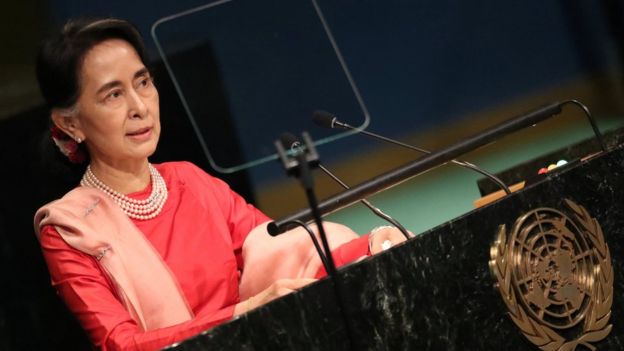
Myanmar's Aung San Suu Kyi to miss UN General Assembly debate

by on 12:19 p. m.
Myanmar's de facto leader Aung San Suu Kyi is to miss a key UN debate next week as criticism grows of her handling of a crisis involving the Rohingya Muslim minority.

Some 379,000 Rohingyas have fled to Bangladesh since violence began last month. Whole villages have burned down.
The UN has accused the government of ethnic cleansing.
Myanmar's military says it is fighting Rohingya militants and denies reports that it is targeting civilians.
The Rohingya, a mostly Muslim minority in Buddhist-majority Rakhine, have long experienced persecution in Myanmar, which says they are illegal immigrants. They have lived in Myanmar, also known as Burma, for generations but are denied citizenship.
The UN Security Council is due to meet on Wednesday to discuss the crisis.
The organisation's refugee agency says not enough aid is getting through to the Rohingya who have fled to Bangladesh.
On visiting a camp, the UNHCR's George William Okoth-Obbo said there needed to be a massive increase in help.

Has Aung San Suu Kyi changed her mind?

Ms Suu Kyi had been expected to participate in discussions at the General Assembly session in New York, which runs from 19 to 25 September.
A government spokesman, Aung Shin, told Reuters news agency that "perhaps" Ms Suu Kyi has "more pressing matters to deal with", adding: "She's never afraid of facing criticism or confronting problems."
Another spokesman said Ms Suu Kyi would instead address the nation on TV on 19 September and "speak for national reconciliation and peace".
In her first address to the General Assembly as national leader in September last year, the former opposition icon defended her government's efforts to resolve the crisis over the treatment of the Rohingya.
The Nobel Peace Prize winner, who lived under house arrest for 15 years for her pro-democracy activism, is widely seen as the head of government in Myanmar.
Ms Suu Kyi has been criticised by former supporters in the West for failing to do enough to prevent the violence in Rakhine state.
Last week she said that the crisis was being distorted by a "huge iceberg of misinformation".
Fellow Nobel laureates, including the Dalai Lama, Archbishop Desmond Tutu and Malala Yousafzai, have called on Ms Suu Kyi to stop the violence.

What is happening in Rakhine state?

The latest wave of Rohingya fleeing their homes began on 25 August, following attacks by Rohingya militants on police and military posts.
Those who have fled say Myanmar troops responded to the attacks with a brutal campaign of violence and village burnings aimed at driving them out.

Trump confirma a la joven Hope Hicks para pilotar su complicada estrategia de comunicación

by on 9:59 a. m.
Tiene 28 años, formó parte del equipo de campaña y es amiga de la hija del presidente

La dirección de comunicación de la Casa Blanca, un puesto clave en Washington -y rematadamente complejo en el Washington de Donald Trump-, queda en manos finalmente de Hope Hicks, la mujer de 28 años que fue jefa de prensa del equipo de campaña electoral y que asumió el puesto de forma interina este verano, después del sonado despido de Anthony Scaramucci. Todo en la comunicación de la nueva Administración americana se ha demostrado imprevisible e inflamable.
Fuentes de la Casa Blanca y la propia Hicks han confirmado el nombramiento este martes, aunque ya era un secreto a voces. El de director de Comunicación -distinto del de portavoz, que es quien tiene el contacto directo con los periodistas a diario- era un puesto vacante hasta el pasado julio, cuando Trump se lo confió a Scaramucchi, un ejecutivo de Wall Street que parecía más bien anatema de las relaciones públicas. En tan solo 10 días enfangó tanto la imagen del Gobierno que ya no llegó a ver el undécimo día.
Al rescate acude Hicks, una millenniall de Connecticut que trabajó como modelo y también como relaciones públicas de la firma de moda de Ivanka, la primogénita del presidente. Se la considera muy cercana a la familia y ha sobrevivido a todos los vaivenes del universo Trump desde la campaña electoral, pasando por el periodo de transición y estos 10 meses plagados de polémicas, dimisiones y despidos.
La directora de Comunicación trabaja, de hecho, con Sara Huckabee Sanders, el nuevo rostro de las ruedas de prensa diarias de la Casa Blanca después de la dimisión de Sean Spicer en julio. Aquella renuncia puso fin a seis meses de tensiones con la prensa, contradicciones permanentes con el presidente y algunos errores sonados. Con un trabajo muy complicado -dar la cara los medios por todas asa contradicciones del Gobierno-, Spicer resultó un personaje muy peculiar de la Administración de Trump. La parodia que la cómica Melissa McCarthy hacía de él en Saturday Night Live le acaba de deparar un premio Emmy.
Como a muchos de los que han rodeado a Trump desde la campaña electoral, a Hope Hicks también le afecta la investigación de la llamada trama rusa, que es la injerencia de Moscú en las elecciones estadounidenses, que los servicios de Inteligencia y el FBI dan por segura, y la posible connivencia del empresario neoyorquino. El fiscal especial estadounidense que investiga el caso, Robert Mueller, ha avisado a la Casa Blanca de que sus investigadores pueden interrogar a varios asesores, según publicó la semana pasada The Washington Post, y entre ellos figura la joven Hicks.

Maduro busca retomar el diálogo con la oposición para evitar las sanciones europeas

by on 9:36 a. m.


La información que el canciller venezolano, Jorge Arreaza, ofrece de gira por Europa da por hecha la reanudación de las negociaciones


Cuando este martes el ministro de Exteriores francés, Jean-Yves Le Drian, anunció desde París que el miércoles tendrá lugar un nuevo intento de negociaciones entre representantes del Gobierno de Nicolás Maduro y de la oposición venezolana, paradójicamente, no solo puso en riesgo las conversaciones, sino que además evidenció la ansiedad de Caracas por mostrar algún indicio de diálogo que permita evitar, o al menos posponer, las inminentes sanciones europeas contra Venezuela.
"Me alegró saber que el diálogo con la oposición se reanudará mañana en Santo Domingo", dijo Le Drian a su salida de una reunión con el canciller venezolano, Jorge Arreaza, de gira por Europa.
Sin embargo, fuentes diplomáticas aseguraron a EL PAÍS que la declaración del ministro francés estuvo motivada por los reportes imprecisos de Arreaza, quien dio por hecha la reanudación del diálogo con la oposición cuando, en realidad, la del miércoles es apenas una reunión exploratoria.
El canciller venezolano –quien este miércoles será recibido por el ministro español de Exteriores, Alfonso Dastis– intenta persuadir a los gobiernos del continente acerca de la inconveniencia de que la Unión Europea adopte sanciones económicas y diplomáticas contra el régimen chavista justo cuanto este se abre a conversar con sus adversarios.
No fue por ello gratuita la advertencia que también hizo el propio Le Drian, durante sus declaraciones a la prensa en París, quien dijo que en su reunión con Arreaza había recordado al canciller venezolano el "riesgo de sanciones europeas y la necesidad de contar rápidamente con evidencias de que Venezuela está lista para relanzar las negociaciones con la oposición y para comprometerse en un proceso sincero y creíble".
Venezuela enfrenta una severa crisis económica y social que ha llevado a la escasez crónica de productos de consumo básico y al impago de obligaciones comerciales con proveedores y aerolíneas internacionales, entre otros acreedores. Para mantener un funcionamiento mínimo y evitar el temido defaulten sus compromisos de deuda soberana, el chavismo necesita dinero fresco, cuyo acceso ya se le hizo difícil tras las sanciones financieras impuestas el pasado 25 de agosto por Estados Unidos. Unas medidas de corte similar desde Europa no harían más que agravar el trance para el Gobierno de Maduro.
El presidente venezolano saludó públicamente el reinicio de las conversaciones, durante una transmisión en cadena nacional de radio y TV este martes en la noche desde el Palacio de Miraflores en Caracas, a su regreso de una breve gira internacional que lo llevó a Kazajistán y Argelia.
"Acepto esta nueva etapa de diálogo", dijo Maduro. "No digo más, porque debemos ser prudentes para que estas conversaciones tengan éxito", finalizó.
En efecto, para este miércoles está prevista una reunión en Santo Domingo por invitación del presidente dominicano, Danilo Medina, y los auspicios del expresidente del Gobierno español, José Luis Rodríguez Zapatero, quienes ensayan una nueva iniciativa de mediación a solicitud de Maduro y con el consentimiento condicionado de Washington.
En la noche del martes, Stéphane Dujarric, vocero del secretario general de Naciones Unidas, Antonio Guterres, expidió en Nueva York una declaración en la que expresa el apoyo del organismo internacional a la iniciativa. "El secretario general reitera su firme convicción de que la situación en Venezuela requiere de una solución política basada en el diálogo y el compromiso y la oposición que asegure la coexistencia pacífica de todos los venezolanos", se lee en el comunicado.
Sin embargo, la dirigencia opositora se mostró contrariada por el anuncio hecho prematuramente desde París. Apenas unas horas después de conocerse, la Mesa de Unidad Democrática (MUD) aclaró a través de otro comunicado firmado en Caracas que el evento del miércoles en Santo Domingo no representa "el inicio de un diálogo formal con el Gobierno", pues, explica la alianza opositora, "el tiempo de gestos simbólicos se ha terminado (…) Exigimos acciones inmediatas que demuestren verdadera disposición a resolver los problemas nacionales y no para ganar tiempo".
En el documento, la oposición reduce los contactos preliminares de este miércoles en República Dominicana a una "diligencia complementaria" de cuya eventual viabilidad "informaremos al país".
Para retomar las conversaciones, la oposición ha exigido al Gobierno, entre otras condiciones, la entrega de un gesto previo de voluntad negociadora, como lo sería la liberación de los presos políticos. La oposición también ha pedido al Gobierno comprometerse a mantener en secreto el curso de las conversaciones. Con esto último no sólo quiere moderar los efectos de la repulsa que la sola idea de las negociaciones produce en los sectores más radicales de la oposición sino, sobre todo, disipar la sospecha de que el Gobierno de Maduro solo quiere conseguir una fotografía de las reuniones con la oposición para mostrarla ante la comunidad internacional como una prueba de su disposición al diálogo.
A pesar de esa solicitud, el expresidente Rodríguez Zapatero y el canciller dominicano, Miguel Vargas, publicaron el martes por la tarde una nota conjunta en la que los mediadores invitaron abiertamente a las partes a "transitar un proceso de negociación y acuerdo político" que, continúa la misiva, "debe estar presidido por el máximo respeto a los principios de la democracia, los derechos humanos, el compromiso social y a la soberanía nacional, y desarrollado sobre la base de una negociación formal y con garantías que den confianza y credibilidad".
Rodríguez Zapatero y Vargas se dicen convencidos de que, con ocasión de la nueva iniciativa, existe "una oportunidad para un proceso de encuentro, reconocimiento mutuo y reconciliación" que habría que aprovechar.
El presidente Maduro nombró al alcalde del municipio Libertador de Caracas y exvicepresidente de Hugo Chávez, Jorge Rodríguez, como jefe de la Delegación del Gobierno que asistirá a República Dominicana. Se supo, por otra parte, que Julio Borges, presidente de la Asamblea Nacional y dirigente del partido Primero Justicia (PJ), encabezará al grupo de voceros de la oposición.

Florida afronta una larga y costosa reconstrucción tras el paso del huracán Irma

by on 9:34 a. m.
En 12 horas destrozó carreteras, barcos, coches y tendidos eléctricos, y mató al menos a 12 personas en Florida. Pero la resaca de Irma durará semanas y, en muchos casos, meses. Mientras el huracán, convertido en tormenta tropical, se desinflaba a su paso por Carolina del Sur, 13 millones de personas —5.5 millones de usuarios— seguían este martes sin electricidad en Florida. Los equipos de emergencia y las agencias del Gobierno trabajaban sin descanso para restaurar la normalidad, pero pese a la reapertura de aeropuertos y comercios en buena parte del Estado, la vida tardará en volver a su cauce habitual.


Los Cayos, en el sur del Estado, donde Irma aterrizó con toda su ferocidad, continuaban sin conexión telefónica, suministro eléctrico y desabastecimiento de alimentos y gasolina. Los 10.000 residentes que no evacuaron la zona temían ahora ser desalojados por la precariedad de la situación. Las únicas dos carreteras que conectan la delgada península con el resto de Florida permanecían bloqueadas por los daños materiales.

MÁS INFORMACIÓN
“Espero ver otra vez el sol, porque viene la noche más larga de mi vida”
El día D en un refugio de Miami
“Pasó Irma y nos quedamos con Trump”
Naples, otra de las víctimas más directas de Irma, situada en la costa oeste de Florida por donde subió el tifón, se levantaba bajo mínimos mientras las autoridades todavía evaluaban los desperfectos. Las colas se alargaban a las puertas de las ferreterías; todo el mundo tenía algo que arreglar. Y los coches invadían los aparcamientos de los pocos restaurantes en funcionamiento. “Esto ha sido malo, pero ya está abierto el McDonald’s”, resumía una vecina. Pese a que en esta área no se han registrado todavía víctimas mortales, el paso del tifón causó complicaciones médicas para muchos jubilados y familias que ocupan esta zona residencial.

Miami respiraba con más tranquilidad. Los barrios de Brickell y Miami Beach, dos de los más inundados por Irma, reabrían sus calles. Los primeros restaurantes colgaban el cartel de abierto y muchos volvieron al trabajo. Quienes se hospedaron en hoteles durante la tormenta vaciaban sus habitaciones para regresar a sus casas, pese a que desconocían en qué condiciones estarían. “A ver si hoy podemos entrar. Ya intentamos ir el lunes y estuvimos tres horas atascados en el puente de acceso. La policía no dejaba pasar a nadie”, comentaba Blanca, residente de Miami Beach.

El norte de Florida y los Estados de Carolina del Sur y Carolina del Norte, todavía sufrían inundaciones tras el paso de la violenta tormenta. Jacksonville, una ciudad costera en el noreste de Florida, era una gran piscina por el desbordamiento del río St. Johns. El nivel del agua llegó a alcanzar los dos metros de altura sobre el nivel del suelo en las zonas céntricas de la ciudad. Charleston, otro popular destino turístico de la costa este ubicado en Carolina del Sur, sufrió también inundaciones, un poco más leves a medida que Irma se difuminaba por el mapa estadounidense.